


Onyks™ PLATFORM
Cognitive Electronic Warfare. Deployed.
ONYKS™ functions across the entire electronic warfare spectrum: Electronic Support, Electronic Attack, and Electronic Protection.
The platform identifies threats in RF, acoustic, and optical domains, classifies them automatically, and responds within seconds while maintaining friendly operations.

Six Stages: Detection to Adaptation
1-3 - simultaneous sensors for domain Detection
The platform functions through a continuous six-stage cognitive cycle. Detection occurs across three sensor domains simultaneously: RF monitoring identifies control signals and telemetry; acoustic arrays classify threats by sound signature; and hyperspectral imaging detects spectral anomalies that are invisible to conventional optics. All sensor data feeds into the Neural Engine for real-time analysis.
4 - classification
Classification does not rely on fixed signature libraries. The cognitive engine evaluates inputs from various domains, assesses threat probability, identifies potential platform types, and suggests responses. Human operators receive threat assessments with confidence levels and recommended actions. Operators approve engagements before the system responds. The cognitive engine reduces decision time by managing data fusion and threat classification, enabling operators to make quicker decisions since the analysis is already completed.
5 - response
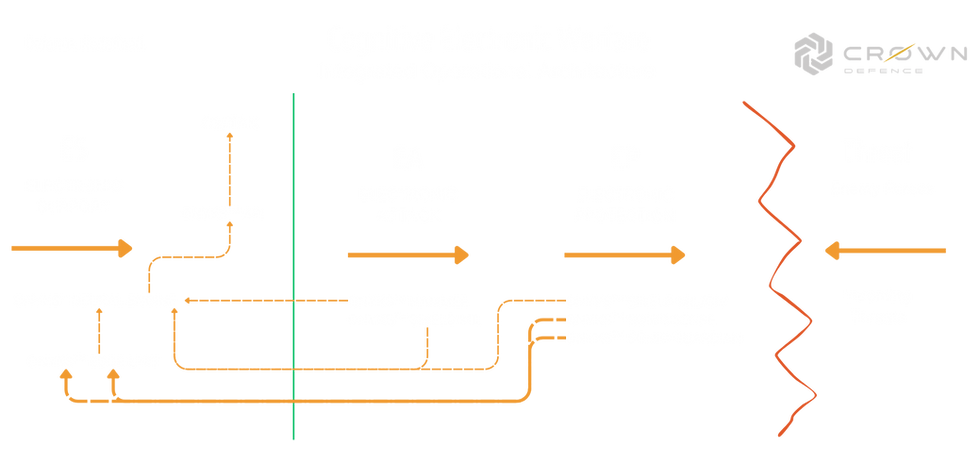
Response occurs through selective electromagnetic engagement. RF defence systems target only hostile signals—control links, navigation, telemetry—while maintaining friendly and civilian frequencies. Throughout active engagements, your communications continue normally. Coalition partners operate without interference. This selective engagement differentiates cognitive EW from legacy systems that create electromagnetic dead zones.
6 - adaption
The cycle does not end with neutralisation. The system continually monitors engagement effectiveness and feeds the results back into the learning model. If threats adapt their behaviour, the Neural Engine adjusts countermeasures automatically without the need for manual signature updates.

Full-Spectrum Electronic Warfare
Most EW systems focus on a single domain. ONYKS™ combines all three, recognising that modern threats do not respect doctrinal boundaries.
Electronic Support offers passive detection and intelligence gathering. Sensors monitor discreetly without revealing their presence. Threat tracks appear in C4ISR systems in real time using TAK-compliant protocols. Pattern analysis pinpoints staging areas, ingress routes, and operational behaviours before threats come within engagement range.

Offers passive detection and intelligence gathering. Sensors monitor discreetly without revealing their presence. Threat tracks appear in C4ISR systems in real time using TAK-compliant protocols.
Pattern analysis pinpoints staging areas, ingress routes, and operational behaviours before threats come within engagement range.
Electronic support
Capabilities activate when threats exceed established thresholds. The platform delivers precise RF effects, selective jamming designed to disable hostile systems using minimal effective power.
Advanced effector systems provide hard-kill electromagnetic interdiction when proportionality necessitates it.
electronic
attack
Maintains friendly operations during all engagements. The cognitive engine distinguishes friendly frequencies, civilian infrastructure, and hostile activity.
It targets only threats. Your radios work. Your navigation functions. Your sensors remain operational. This is the critical difference from legacy EW.
electronic protection
Integration happens through open APIs and standard protocols. The platform links to existing C4ISR infrastructure without needing a full system overhaul.
We provide capability. You maintain command authority.
From Components to Systems
The ONYKS™ platform consists of modular components that integrate into a unified system. Each component meets specific operational needs while ensuring interoperability within the architecture.
Multi-domain sensor nodes providing continuous surveillance across acoustic, RF, and optical spectrums.
Distributed network architecture with autonomous operation and self-organising mesh connectivity.
Detection and Sensing
Neural Engine and edge computing units analyse sensor data at the tactical edge.
Machine learning models operate locally without relying on cloud services, allowing real-time threat classification and autonomous learning from operational experience.
Cognitive Processing
Selective RF engagement systems create protective coverage zones. The platform scales from tactical to operational levels through modular architecture.
Military and civilian variants cater to different regulatory and operational requirements.
Electronic Defence
Electromagnetic interdiction capabilities for proportional responses to high-threat scenarios.
Effector Systems
Hyperspectral detection systems identify threats beyond visible wavelengths.
Mission-configurable processing with real-time edge analytics and standard tactical data outputs.
Intelligence Layer
with TAK-compliant protocols and open APIs enables connectivity with C4ISR systems, third-party sensors, and existing defence infrastructure.
Integration framework
Detailed product specifications, configurations, and operational parameters are available upon request.

deployment: tactical to strategic
The architecture scales from tactical to strategic levels through a modular design.
mounted operations
Mounted operations integrate systems into vehicles, vessels, and fixed structures. Similar hardware can be adapted for different platforms through software configuration; forward operating bases, convoy vehicles, naval installations, and border posts all utilise the same core technology with mission-specific settings.
dismounted operations
Dismounted operations support tactical units with man-portable variants. The system breaks down into components that soldiers carry. Setup times are measured in minutes. Individual sensor nodes fit into cargo pockets for deployment during movement.
distributed networks
Distributed networks cover extensive areas using autonomous sensor meshes. Deploy nodes from vehicles, aircraft, or manually. Networks self-organise, establish connections, and start reporting without manual setup. Add sensors to increase coverage. Relocate assets as threats evolve.
scalability
Scaling occurs in two dimensions: geographic coverage expands by adding sensors, while engagement capacity grows by deploying more effector units. Cost per square kilometre varies depending on mission requirements; you implement only the capability needed for the threat faced.

Tested in real conditions
ONYKS components are tested in real operational conditions, with ongoing development based on field experience. Testing takes place in environments that mirror the actual conditions in which systems will operate, such as contested electromagnetic spectrum, challenging weather patterns, and operationally realistic scenarios.
This ongoing testing approach means the platform develops based on what is effective in practice, not theory. Sensor performance advances. Classification algorithms improve. Response tactics adapt. The architecture was designed for continuous progress from the start, with the Neural Engine processing operational data and refining its models based on real-world performance.
We collaborate directly with operational users who offer feedback that guides development priorities. When operators identify capability gaps or suggest improvements, those requirements feed straight into engineering decisions. Human operators retain decision authority over all engagements. The system provides recommendations, and operators give approval.